Videos play from YouTube only after you press play. Watch on YouTube
Hi, my name is Prince Chenou.
Transcript
Transcript generated from the video captions. It may contain small errors.
Welcome back everybody. Hope you all are having a blessed day. In this video, I want to talk about how you can lower your taxes as a high-inccome W2 earner. If that sounds interesting to you, let's get into it. Hi, my name is Prince Chenou. I work at a big finance institution and I come on here just to make videos that are simple, practical, and accessible for everyday people like you and me.
So, if that's what you're looking for, you're in the right place. Now, compared to someone who's a business owner, W2 employees don't have as many tax strategies at their disposal, but that doesn't mean that you're out of luck. There are still few powerful strategies that are often overlooked, especially by high income earners.
So, now let's break them down. The first one, max out your employer retirement plan. This could be a 401k, 403b, or 457 depending on where you work. If you are work at a large corporation, you probably have access to your 401k. If you work for a nonprofit, hospital, or a church, you probably have a 403b.
If you're in a government or a public service, it could be a 457 plan. Either way, if you're a high income earner, you should absolutely be maxing this out. Now, why is that? Because your contribution or pre-tax, meaning that they reduce your taxable income for the year. So, for 2025, the contribution limit is $23,000 if you're under 50.
and 30,500 if you're 50 or older. That's money that you're saving now on taxes and investing for your future. It's a win-win. Let me give you a simple example that makes this real. Let's say you make a $200,000 a year. If you do absolutely nothing, you'll be taxed on the full $200,000. But let's say if you max out your 401k and contribute 23,000 for the year, now your taxable income drops to $177,000.
And that's 23,000 that you don't pay federal income taxes on for that year. Depending on your tax bracket, this can save you anywhere from six to $9,000 in taxes just by putting money into your future self account. And remember, you're not spending that money. You're investing it for your retirement. So, it's a double win.
Lower taxes today and more retirement savings for tomorrow. Now, moving forward, another great strategy to lower your taxable income as a high income earnner would be maximizing your health savings account. If you're enrolled in a high deductible health plan, you should absolutely be looking into maxing out this account. The HSA for short is hands down one of the most powerful tax advantage accounts available.
Why? Because it gives you three tax breaks in one account. So now here, let me break it down for you. One, you get tax deductions for your contribution. The money that you put in reduces your taxable income just like a 401k would. Two, you get taxfree growth. any interest, dividends or investment gains inside the account grows without being taxed.
Three, you get taxfree withdrawals. If you use the money for a qualified medical expense, you pay zero taxes when you take it out. So, the money is taxree going in, taxree while it grows, and then taxree taken out. Now, let's put some numbers behind it. Let's say you're a high income earnner with the family and you max out your HSA by contributing $8,550 in 2025.
that amount gets deducted from your taxable income. So, if you're in a 35% federal tax bracket, you can save nearly $3,000 in taxes that year alone. Meanwhile, if you invested the money, let it grow for 20 years, you end up with tens of thousands of dollars tax-free to cover medical expenses in retirement.
And here's the kicker. After age 65, you can even withdraw the funds for not for non-medical expenses. You just pay the regular income taxes just like a traditional IRA. So, it becomes a backup retirement account if you don't end up using all of the all of it for medical expenses. Also worth noting, unlike a FSA, which is a flexible spending account, money put into HSA rolls over year-over-year, and the account is yours forever, even if you change jobs or retire.
So, whether you're looking to reduce your tax bill now, or you want a cushion for medical costs in later on your life, the HSA is a no-brainer if you're eligible. Now, let's talk about one of the most valuable long-term tax strategies for our high- income earners, the Roth IRA, and more specifically, the back backdoor Roth IRA.
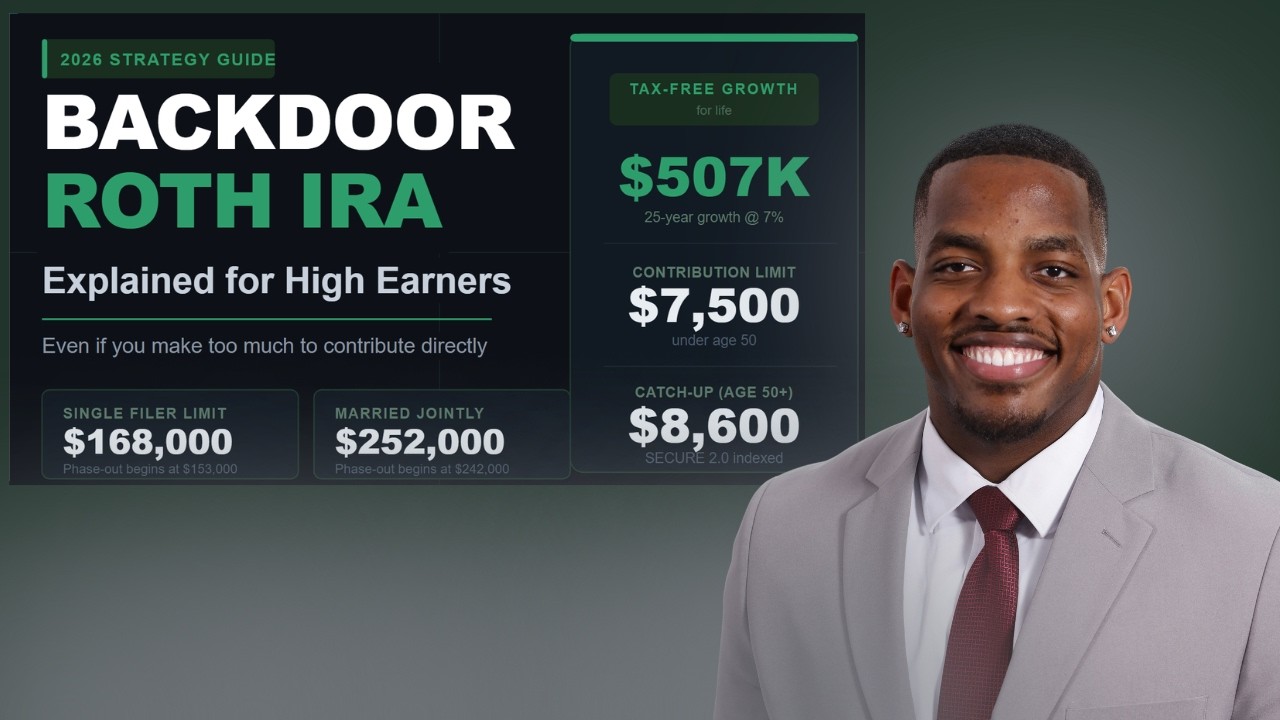
As a high-income W2 earner, you may already know that once your income hits a certain level, you're no longer eligible to contribute directly to your Roth IRA. For 2025, if your modified adjusted gross income is over $161,000 if you're single, or $240,000 if you're married, your ability to contribute starts to phase out and eventually disappear.
But here's the good news. You can still get money into your Roth account through what's called a backdoor Roth strategy. Here's how it works. First, you contribute after tax dollars to traditional IRA. For 2025, the limit is $7,000 if you're under 50 and $8,000 if you're 50 or older. Then you convert the traditional IRA to a Roth IRA because you've already paid taxes on the contribution.
The conversion is typically tax neutral, meaning that there's little to no extra tax due. Now, here's where the magic happens. That money is now inside your Roth IRA where it can grow completely taxfree. And when you take it out in retirement, as long as you follow the rules, your withdrawals are 100% taxree.
Plus, the Roth IRA comes with another major benefit. No required minimum distributions. That means that you're not forced to withdraw money at a certain age like you are with your 401k or your traditional IRA, giving you way more control over your tax planning in retirement. So, this strategy doesn't lower your taxes today, but it sets you up for major tax-free income down the road.
And this could be a great hedge against rising taxes in the future. Now, let's shift gears and talk about how you can be more tax efficient inside your investment portfolio. When you're a high income earner, it's not just about how much money you earn, but it's also how about how much money you keep.
And often taxes on investment can quickly eat away at your returns if you're not paying attention to it. One overlooked but powerful tool, especially for people living in high tax states like California, New York, or New Jersey, is investing in municipal bonds. Municipal bonds or munis for short are issues by state and local governments to fund public projects.
Think of things like schools, roads, or infrastructure. And what makes them even more attractive is that the interest you earn from these bonds are exempt from federal taxes. But here's the real kicker for high earners. If you buy municipal bonds issued by your own state, the interest income can also be exempt from state and local income taxes.
So, for example, if you live in California and you buy California issued municipal bonds, your interest could be completely tax-free at every level. Now, imagine if you're in 37% federal tax bracket, plus your state income tax is 10%. That's nearly half of your income going towards taxes. Generating tax-free income from municipal bonds can be a huge win, especially if you're looking for steady, lowrisk income in retirement, or you just want a portion of your portfolio that doesn't get taxed every year.
Another great way to manage taxes in your investment portfolio is through a strategy called tax loss harvesting. Here's the idea. Throughout the year, if you hold any investments like stocks, ETFs, or mutual funds that have declined in value, you can sell them at a loss to offset other investments that have gone up.
Let me break it down with a simple example. Let's say that you have a stock that's down $1,000. You also have a stock that's up $1,000. You can sell both positions and the $1,000 gain is wiped out by the $1,000 loss. And so what's the result? You pay zero taxes on the gain.
Even better, if the total losses exceed the your gains, you can use up to $3,000 in losses each year to offset ordinary income like your W2 income. And if you have more losses than that, you can carry them over in future years. This strategy works best in taxable brokerage accounts and is especially useful during volatile times when some parts of the market may be up or some parts of your portfolio may be down.
To be clear, tax harvesting doesn't change your long-term investment plan. It simply is a way to stay invested while reducing your taxable liability. It's like trimming the weeds without digging out the whole garden. You're staying on track, but you're being strategic about what to cut and when. So whether it's through municipal bonds or harvesting losses strategically, making your investment portfolio more tax efficient is one of the most underrated ways to build wealth over time, especially for high- income earners.
So let's wrap this up. As a high income W2 earner, here are the ways that you can lower your tax burden. One, max out your employer retirement plan. Two, contribute to your HSA if you qualify. Three, use a Roth IRA or a backd dooror Roth strategy. Four, make your portfolio more tax efficient with municipal bonds and tax loss harvesting.
These ideas aren't just random. They're real and actionable strategies that can save you thousands of dollars over the years if done consistently. So, if this video helped you, please go ahead and like the hit the like button. Please subscribe, put a comment down below. Would love to hear you all's thoughts. Thank you so much and have a blessed
This video is for general educational purposes only and is not personalized investment, tax, or legal advice. Every situation is different. Talk with a qualified professional about your circumstances before acting. PLC Wealth Partners is a registered investment adviser. See our disclosures.