Videos play from YouTube only after you press play. Watch on YouTube
Why you may need it, different types, how much is adequate, and much more. Hi, my name is Prince Chenou.
Transcript
Transcript generated from the video captions. It may contain small errors.
Hey everybody, I pray you all having a blessed day. In this video, we're going to dive into all things life insurance. Why you may need it, different types, how much is adequate, and much more. So, let's get into it. Hi, my name is Prince Chenou. I work in wealth management at a major financial institution, but I come on here just to make videos to help make personal finance simple, practical, and accessible for people just like you and me.
My goal is to break down money topics as much as I can so you can take decisions with confidence. Let's jump in. One area of financial planning that's often overlooked, but it's absolutely critical is life insurance. Too many people think that they either don't need it or it's only something that they should be thinking about later on in life.
But the truth is life insurance is not just about planning for death. It's about protecting the people and commitments that you depend on you honestly. So, if you're the main breadwinner in your family or you have kids or you have debts that won't be forgiven if you passed away or even if you own a home that you would like to be passed down to your family, life insurance is the tool that can make that happen.
Even beyond family, if you're a co-owner of a business, life insurance can protect your business partner and keep the business going if something were to happen to you. In short, if anybody depends on you for financial support, you'll need a plan in place. I know life insurance isn't something that's talked about as much.
For some, it's even considered taboo, but it's a critical part of financial planning, especially when it comes to risk management. Now that we talked about why life insurance is important, the next big question is what kind of life insurance should I be getting or look for? Well, there's many types of life insurance out there.
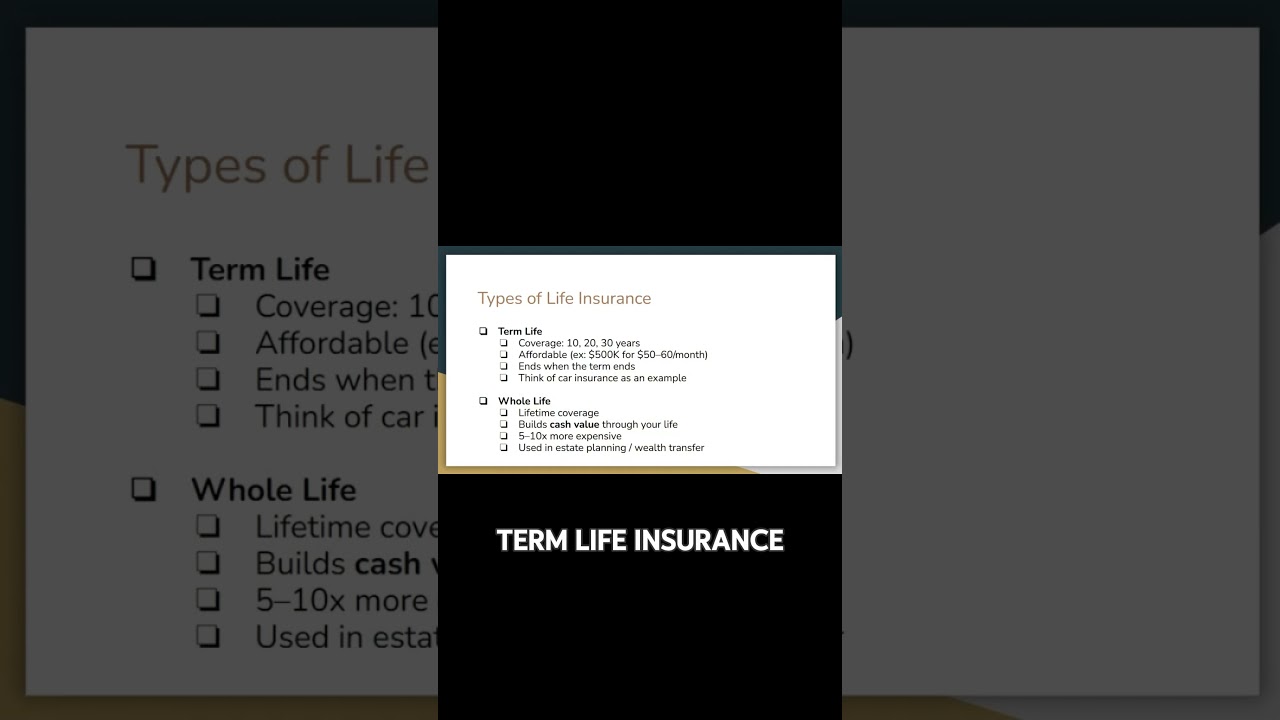
There's two main common ones. Whole life and term life insurance. Term life insurance gives you coverage for a set number of years. 10, 20, 30 are most common. and it's usually most affordable. For example, a healthy 30-year-old might get a 500,000 policy for $50 to $60 a month. If you pass away during that period, the beneficiary gets to pay out.
If you outlive it, the policy ends. Another way of thinking about it was say with car insurance. Hopefully, many people out there have car insurance. You tend to have a contract for a set amount of time that you'll be covered for and you'll pay your premiums monthly, quarterly, or bannually and hope that you never have to use it, but when you need it, the insurance is there.
This is the same concept with term insurance. Whole life insurance on the other hand lasts your entire life as long as you're paying your premiums. This has a cash value component that grows over time and it's more expensive sometimes five to 10 times the cost of term insurance but it can be utilized for certain estate planning or wealth transfer strategies.
Now once you understand the types of insurance available, the next natural step is figuring out how much coverage do you actually need. This is where concepts like human capital or financial capital come into play. Think of human capital as the value of all the money you earn throughout your lifetime. and the financial capital as the assets that you have already accumulated like your savings, investments, and properties.
You can also think of it like potential versus kinetic energy. If you are if you're early in your career, you have a lot of human capital, meaning that you have more years of earning ahead of you, but less financial capital saved up. That's really where life insurance plays a huge role. As a general rule of thumb, 10 to 12 times your annual income is what you should get for life insurance.
So, if you're making $80,000 a year, you might like to get 800,000 to a million in coverage. But remind this is just a rule of thumb. How much insurance you actually need is very dependent on your own situation and own circumstances. And if you want more precise numbers, you can either do a human life value analysis or a needs analysis.
Human life value looks at your earning potential over your entire career, not just how much you're making today. It's about the economic value that you'll bring to your family through your earnings or income, benefits, and even services you provide. So, for example, if you're earning $120,000 a year and you plan to grow that over the next 30 years with the raises, bonuses along the way, the present value of all those future earnings could be easily over $3 million.
That's the financial engine that your family relies on, not just to cover bills, but to fund their lifestyle, education, long-term goals. Now, that's one way of looking at it. But the other way is what's called with the needs analysis, which looks beyond just your income and focuses on the actual expenses and lifestyle that your family would need.
A needs analysis looks at what your family would actually need if you weren't there. And not just to pay off debt, but to maintain their lifestyle. For example, paying off the mortgage might be a priority. But what about replacing your income for the next 10 to 15 years so your spouse doesn't have to go back to work immediately?
or funding for your kids' college. Life insurance isn't designed to create wealth. It's designed to give your family the breathing room to grieve, adjust, and move forward without the financial strain. And remember, your needs changes over time, too. A young family with toddlers might need more coverage now than a 20 than 20 years later when the kids are independent.
Now, once you figured out your coverage needs, there's a smart way to structure your insurance so you're not overpaying. This strategy is called term layering. A method of structuring life insurance coverage that combines multiple term policies with different lengths to match changing financial responsibility over time. How it works? Instead of just buying one large policy that lasts for decades, you purchase a base policy and then you add smaller policies later on as you your niche changes or increases such as whenever you have a kid, you buy a house or you take on other obligations.
There's multiple benefits for this. So, one, cost efficiency. Avoiding paying for unnecessary coverage beyond your peak financial responsibility years. Two, flexibility. It allows you to adjust your coverage as your life situation changes. Three, targeted protection ensures higher coverage for when dependence and debts are at the highest. So, for example, let's say you start off with a 20-year 500,000 term policy at age 30.
At age 35, you have two kids. You buy large house. Then you add a 15 or $250,000 policy. By age 50, when the shorter coverage ends, your mortgage is smaller. Your kids are independent, and you no longer need the extra coverage, leaving you with just the original policy when it expires. Now, of course, many people stop here and think, "Well, I already have insurance through work.
Shouldn't that be fine?" Well, here's the problem. Employer coverage is rarely enough. There are a couple things that you should be aware of. Many people that have life insurance through work often times it's just one to two times your salary. Of course, it's better than nothing, but that's barely enough at times. And here's the big issue.
If you leave your job, that coverage often times doesn't come with you. And even if it's portable, you usually have to pay the premiums yourself, which can be higher and more expensive. So, if your co work coverage isn't enough, you might be wondering, is buying your own policy really affordable? The good news is yes.
Yes, it is. Term life insurance is very affordable for most people. A healthy 30-year-old might pay $50 to $60 a month for $500,000 in coverage. Or for my situation, I was able to find a 30-year policy, $500,000 in coverage for only $20 a month. The beautiful thing is that the premium that I'm paying is fixed throughout the life of the policy.
So, for the peace of mind that it brings, that's a small investment compared to the potential financial disaster of not having coverage. Now that we've covered why, what, how, and how much, let's bring it all together. Some simple action steps that you can take today. Here's how you put it to into action.
One, decide who you're protecting: your spouse, kids, business partners, anybody else. Two, figure out your coverage amounts. General rule of thumb is 10 to 12 times your income, but you could do a full analysis to truly understand how much you need. Three, choose your policy type. Most people term life insurance the simplest, most affordable starting out.
Four, don't only rely on your employer employer policy. Get your own policy so it's portable if you were to change jobs or if anything else were to happen. Five, review your coverage every few years. Life changes. You may have a kid, you may buy a home. So, you want to make sure that your insurance can handle that.
So, in closing, insurance isn't for you. It's for the people that you love. It's one of the most simplest ways to make sure that they're taken care of no matter what happens. If you find this video helpful, please hit the like button, subscribe, put down comments, any any thoughts that you may have.
Thank you. And I pray that you all have a blessed
This video is for general educational purposes only and is not personalized investment, tax, or legal advice. Every situation is different. Talk with a qualified professional about your circumstances before acting. PLC Wealth Partners is a registered investment adviser. See our disclosures.