Videos play from YouTube only after you press play. Watch on YouTube
Let's talk about life insurance, especially term versus whole life, and why for most young individuals term makes more sense.
Transcript
Transcript generated from the video captions. It may contain small errors.
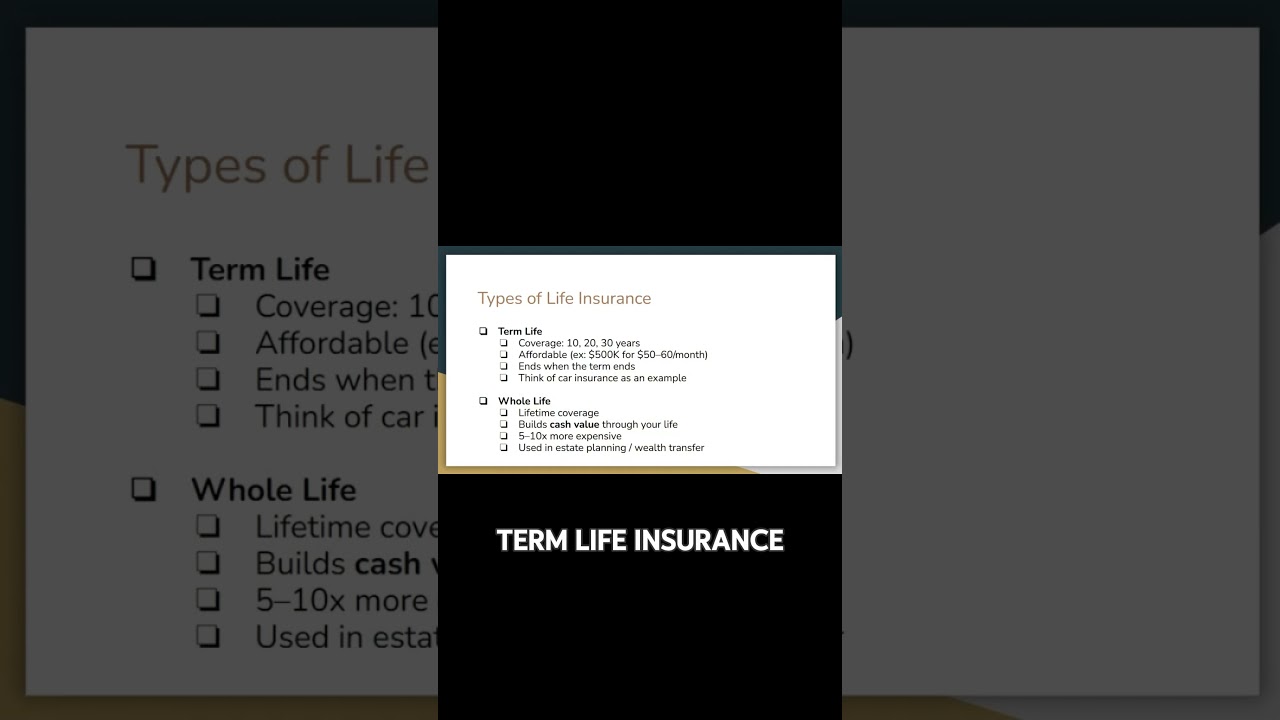
Let's talk about life insurance, especially term versus whole life, and why for most young individuals term makes more sense. The first reason is simple, and that's the cost. Term life insurance is significantly cheaper than whole life, sometimes a fraction of the price for the same death benefit, and that difference matters because the money you save can go towards your budget, or better yet, go towards investing.
The second reason comes down to what you're actually trying to protect. Most young people don't need coverage forever. You need coverage for a season of your life. Think about it. A mortgage that you're trying to pay off in, say, 20 or 25 years. Student loans that you're working through right now. Debt that you want covered if something were to happen to you.
Income replacement while your kids are still growing up. These are the specific needs with a specific timeline. Term life is built exactly for that. You choose the length of time, say, 10, 20, even 30 years, and then you can match it with the years that you're actually needing coverage for. And then there's a third reason, and that's simplicity.
Whole life policy comes with a lot more moving components. We're talking about cash values, loan provisions, fees built into the structure. Term life is pretty straightforward. You pay your premium, and then if you were to unfortunately die, you get the death benefit. That's it. Now, term life gets criticized for one particular reason.
There's no cash value that's built in the plan. When the policy ends, if you're still alive, you get nothing back. Some people see that as a negative, but flip it around. There's a trade-off for a lower premium. If you were to take what you save and invest it yourself, you're building your own cash value on your own terms in your own accounts.
And with this, you would have more control than the policy could ever give you. Now, that doesn't mean that whole life is never the right move. There are cases where it makes sense to have a whole life policy. Say, if you have a permanent need for coverage that doesn't go away. Say, you have a dependent with a special needs children, or someone who relies on care or support for their entire life.
Whole life can make sense there. Estate planning is another one. If you're dealing with estate taxes, if you want to leave a guaranteed tax advantage inheritance behind. Whole life can be a tool for that. Business owners can use it, too, for buy-sell agreement or key person insurance, where the coverage needs to last as long as the business does.
And honestly, some people simply value the force saving component, the discipline of a policy that builds a cash value over time, even if the growth is slower than what you would get investing it directly. So, it's not saying that whole life is bad. It just solves a different problem. For most young individuals, building wealth and covering a defined period of risk is more important.
Term life paired with intentional investing tends to be a stronger move.
This video is for general educational purposes only and is not personalized investment, tax, or legal advice. Every situation is different. Talk with a qualified professional about your circumstances before acting. PLC Wealth Partners is a registered investment adviser. See our disclosures.